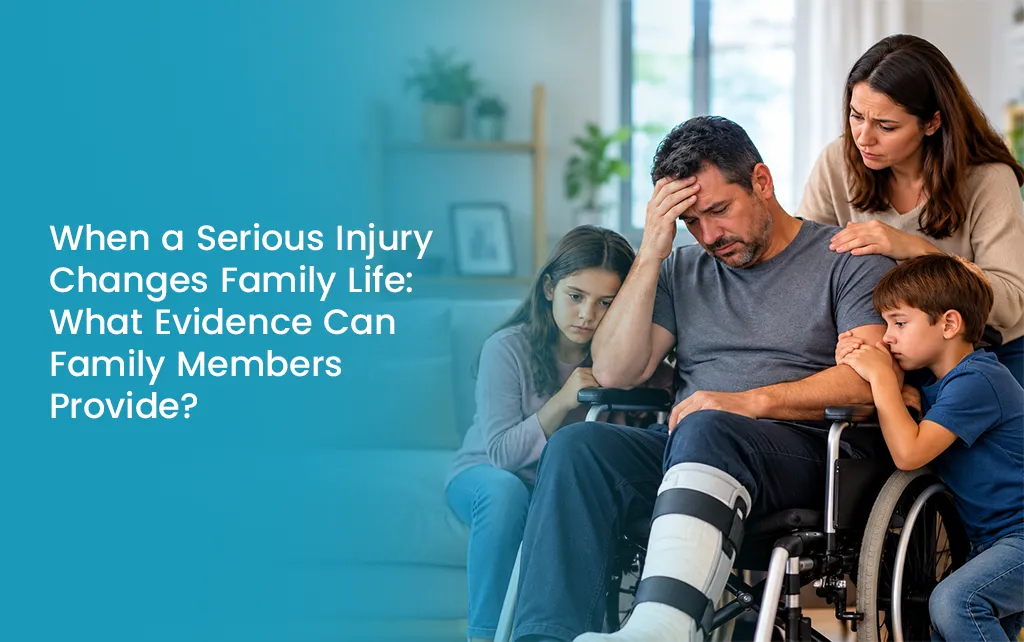
A serious injury rarely affects one person alone. When a partner, parent, child or sibling suffers a life-changing injury, the whole household adjusts: routines shift, money tightens, and relatives take on roles they never expected. Family evidence in serious injury claims records that change from the people who see it every day. This guide explains what spouses, partners, parents, children and other relatives can provide, how they can record it accurately, and how solicitors use it alongside medical and expert evidence in claims under the law of England and Wales.
A serious injury can change work, care, routines, finances and relationships all at once. The impact of serious injury on family life usually reaches far beyond the injured person’s own treatment.
Household roles and routines. A partner may stop sharing the school run, cooking, driving or household repairs. A relative may start helping with washing, dressing, medication, transport and supervision. Children may take on tasks beyond their age, and siblings may rearrange their own plans to help.
Work and income. An injured person may reduce their hours, change role or stop work. Relatives may cut their own hours, take unpaid leave or leave a job to provide care. Loss of earnings after serious injury can affect the injured person and the people who depend on them.
Emotional wellbeing. The psychological impact of serious injury on families is real and varies from person to person. Relatives often describe worry, exhaustion, grief for the life they had, and strain in relationships. These effects matter to the family, and they also show how profoundly the injury has altered everyday living.
Long-term arrangements. Changes in daily living after serious injury may include adapting a home, arranging regular therapy, managing appointments and planning for care over many years. Families who record these changes early give their solicitors a clearer starting point for a claim.
Family evidence matters because relatives see the injured person’s daily reality, which clinical records often capture only in part. Can family members give evidence in a serious injury claim? Yes. Relatives can give factual witness evidence about what they personally saw, heard and did.
Medical records describe diagnoses, treatment and clinical findings. Expert witness reports give independent opinions on matters such as prognosis, rehabilitation, care needs and employment. Family evidence does something different. It describes how the person functioned before the injury, how they function now, and what the household does every day to cope.
That comparison helps in proving the impact of a serious injury. A consultant may see someone for a short appointment. A spouse, parent or adult child sees the same person at breakfast, in the evening and during the difficult moments in between.
Family evidence complements medical and expert evidence. It does not replace it. A claim generally needs appropriate evidence of legal responsibility, causation and loss. Family accounts mainly assist with the last of those, and sometimes with how the injury has affected ordinary life. The court or the other side will consider how credible, relevant and consistent each account is, and the weight given to it depends on the circumstances of the case. No type of evidence guarantees a particular outcome.
Family members can provide factual witness statements, care diaries, records of practical help, travel and expense records, and contemporaneous notes or photographs. Strong evidence for serious injury compensation stays factual, specific and tied to dates.
Factual witness statements. A statement sets out what the relative personally saw and did. Personal injury witness statements work best when they describe the person’s life before the injury, the changes since, and the help the family now provides.
Care and support records. Evidence of care and support after injury can include a note of tasks, how often they happen and how long they take. Examples include washing, dressing, meal preparation, medication prompts, night-time assistance, supervision and attendance at appointments.
Expense records. Relatives can keep receipts, mileage notes and parking tickets for hospital and therapy journeys, together with records of equipment, adaptations and other injury-related costs.
Photographs and messages. Dated photographs of home adaptations or equipment can help. Relatives should only record material they have lawfully obtained and should avoid recording anyone without proper consent.
Employment information. Letters, payslips and notes about reduced hours or time off can show how the injury has changed family finances.
What evidence can a spouse provide after a serious injury? A spouse or partner can describe the person’s abilities, habits, mood and relationship before and after the injury, along with the practical help they now give. Are family witness statements useful in personal injury claims? They can be, particularly when they give concrete examples rather than general opinions.
Adults who need to explore their options can start with a serious injury compensation claim enquiry, where a solicitor can explain which records suit their situation.
Family members can document brain injury changes by recording specific, dated examples of what they observe in memory, communication, behaviour, concentration, mood and everyday functioning. Acquired brain injury, including traumatic brain injury, often leaves effects that other people cannot see in a short meeting.
Brain injury and personality changes are among the most distressing consequences for relatives. A person who was patient may become irritable. Someone organised may struggle to plan a day. Fatigue, slowed thinking, emotional outbursts, reduced insight and difficulty following conversations can all affect family life, even when the person looks well.
How can family members document behavioural changes after a brain injury? They can write down what happened, when it happened, where it happened, what they saw and heard, and how long it lasted. A useful entry states the facts, such as “he asked the same question four times in an hour” or “she left the cooker on twice this week”. It avoids guesses about why it happened.
This detail helps because some consequences of brain injury do not appear in a scan or a routine clinic letter. A careful record of daily functioning gives neuropsychologists, rehabilitation professionals and other experts real-world information to consider. Family evidence for brain injury claims also shows the supervision, prompting and support a person needs to manage everyday tasks.
Brain injury claims involve medical complexity, so many families seek brain injury solicitors early. Documenting less visible consequences is a task where brain injury claims specialists can help families work out what to record and which experts may need to see it. What evidence helps support a brain injury claim? A combination of medical records, specialist expert reports, rehabilitation records and consistent family accounts of changed daily life.
Yes, family members can provide evidence of unpaid care and related losses, although whether a particular loss is recoverable depends on the facts and the legal assessment. Can unpaid care provided by relatives form part of a compensation claim? It can. In personal injury law, this is often called gratuitous care, meaning care that family or friends provide without payment. Courts and solicitors consider whether the care is reasonable and necessary because of the injury, and the law sets rules on how the value is assessed and who holds it.
Unpaid care provided by family members is easier to explain when the record shows:
Can a family member keep a care diary after an injury? Yes, and a family care diary after serious injury is one of the most practical tools a household can use. The diary should record events as they happen or very soon afterwards. A relative who tries to rebuild months of care from memory later will usually produce a less reliable account.
Financial evidence works the same way. Payslips, employer letters, receipts, mileage logs and bank records help show loss of earnings and out-of-pocket costs. Not every expense, financial impact or caring activity automatically qualifies for compensation, and a solicitor will assess which items fall within the claim. In larger claims, the figures go into a schedule of loss, which sets out the claimed losses to date and the future care requirements and costs the claimant says will arise.
Families should record dates, describe specific events, separate what they saw from what they heard, keep original documents and tell their solicitor exactly what happened. What should a family witness statement include? It should include the writer’s name and relationship to the injured person, how long they have known them, the person’s life before the injury, the changes they have seen since, the help they provide, and the effect on the household.
Several habits improve the quality of family witness evidence.
Use precise dates and examples. “Last Tuesday, I helped him dress because his hand tremor stopped him fastening buttons” tells a solicitor more than “he needs lots of help”.
Separate direct observation from second-hand information. A relative should state clearly what they personally witnessed and identify anything someone else told them. Witness statements from family members carry most value when they stay within personal knowledge.
Keep records contemporaneous. Notes made at the time preserve accurate detail. Families must not manufacture, exaggerate or retrospectively change a record. If a relative adds to an earlier note, they should mark the addition with the date it was made.
Preserve originals. Keep the original diary, receipts, messages and photographs. Solicitors may ask to see them, and copies cannot always replace the originals.
Tell the truth, including the good days. A balanced account builds credibility. If the person has better days, say so and describe them. Statements that overstate a person’s difficulties can damage trust in all the evidence.
Witness statements in court proceedings carry a statement of truth, which confirms the writer believes the contents are true. A relative should only sign a statement they have read carefully and know to be accurate.
Time limits also matter. Many personal injury claims in England and Wales follow a three-year limitation period, generally running from the date of the accident or the date the injured person first knew the injury was significant. Special rules and exceptions apply, including for children and for people who lack mental capacity, so families should take advice promptly rather than rely on a general rule.
Solicitors use family evidence alongside medical, rehabilitation, employment and financial evidence to build a full picture of the injury’s consequences and the person’s present and future needs. How do serious injury solicitors assess family evidence? They look at whether the account rests on first-hand knowledge, whether it is specific, whether it stays consistent with other records, and whether it helps prove a point that matters in the claim.
Experienced serious injury solicitors investigate complex claims by gathering medical records, instructing independent experts, and testing each piece of evidence against the rest. A care expert may carry out a care needs assessment. An occupational therapist may comment on equipment and housing. An employment expert may address future work capacity. Family accounts help these professionals see the daily detail behind their assessments.
Solicitors also use family evidence to explain how care has worked in practice. For example, a relative’s diary may show what help the injured person needs each day, which can inform conversations about professional care, rehabilitation and future care requirements. Present losses and future needs then feed into the schedule of loss.
The long-term picture matters too. Long-term rehabilitation after serious injury can run for years, and family observations of progress, setbacks and ongoing limits help experts judge what support the person may need as they age or as their condition changes.
A solicitor will also tell a family honestly which evidence adds value and which does not. Supporting a serious injury compensation claim does not mean providing more paper. It means providing accurate, relevant material that helps the claim.
Taking the next step. Serious injuries change the way families live, work, care and plan. Family evidence in serious injury claims puts that change into clear, first-hand words. Relatives who record dates, describe what they see, keep original records and stay truthful give their solicitors dependable material to work with. Complex claims also need specialist legal guidance, because the evidence of family members sits alongside medical opinion, expert reports and financial documents.
This article gives general information and does not replace advice on your own circumstances. If a serious injury has changed life for you or someone you love, MRH Solicitors can talk through your situation and explain how family evidence may fit your claim. Visit www.mrhsolicitors.co.uk to learn more about the firm’s serious injury services and to get in touch.
The information provided is for general informational purposes only and does not constitute advice. While we strive to ensure the information is accurate and up-to-date, we make no representations or warranties of any kind, express or implied, regarding the accuracy, adequacy, validity, or completeness of any information on this site.