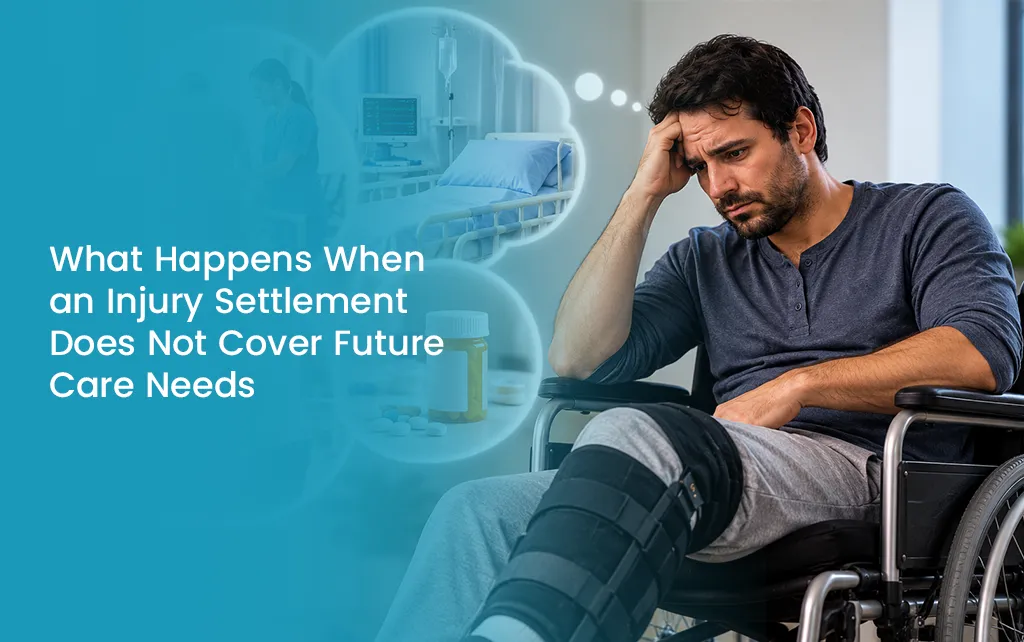
An injury settlement not covering future care needs can leave a seriously injured person paying for carers, therapy and equipment from their own savings years after the claim closes. Serious injury compensation has to fund needs that may last decades, so a settlement that undervalues those needs creates a problem that grows with time.
In England and Wales, most settlements are final. Once a claimant accepts one, the claim ends, and the defendant has no duty to pay more if costs rise. The care assessment completed before settlement therefore carries enormous weight.
This guide explains why shortfalls happen, which future care costs a claim should consider, whether anyone can revisit a concluded settlement, and how provisional damages, periodical payments and specialist advice protect long-term needs. It focuses on England and Wales. Scotland and Northern Ireland have their own rules, so readers there should take advice on the local position.
Settlements fall short when the claim underestimates care needs, relies on incomplete evidence or fails to allow for rising costs. A separate group of shortfalls arises when a person’s condition changes after an agreement that fairly reflected the medical position at the time.
Several recurring problems produce an insufficient personal injury settlement:
An inadequately assessed settlement differs from a settlement that becomes inadequate because a person’s condition changes unexpectedly. The first reflects a flaw in the evidence or the negotiation. The second reflects medical uncertainty, which a final settlement leaves with the claimant unless the parties agree specific protection, such as provisional damages.
A serious injury settlement should consider every reasonable cost of meeting a person’s care and support needs for the rest of their life, as far as the evidence supports. Damages aim to place the injured person, so far as money can, in the position they would have occupied without the injury.
Recoverable costs depend on the facts, the medical evidence and the legal principles that apply, so no list guarantees recovery. A claim for compensation for future care needs commonly assesses:
Future loss of earnings and pension loss form separate parts of the claim, but they affect how far a person can fund care and daily life.
Do not assume that NHS or local authority support will meet these needs. Eligibility depends on individual assessment and varies between areas, so a claim should not rest on an assumption of automatic entitlement.
Care and medical experts assess current needs, project how those needs may change and price them as an annual cost. Medical evidence on life expectancy then supports a multiplier, which the parties or the court apply to the annual figure, taking the discount rate into account. Each step relies on evidence, so weaknesses early in the process carry through to the final figure.
Usually, no. A full and final settlement ends the claim, and a claimant generally cannot reopen it because care costs later increase. Limited exceptions exist, mainly where provisional damages were awarded or agreed before the case ended.
When a claimant accepts a lump sum on a full and final basis, they give up any further claim arising from the injury, including losses that turn out higher than expected. Courts treat these agreements as binding.
Can you reopen a personal injury settlement in the UK? Only on narrow legal grounds, such as fraud or misrepresentation, and never simply because an estimate proved too low. Settlements for children and for protected parties, meaning people who lack capacity to conduct their own claim, need court approval in England and Wales. That approval adds a safeguard at the time of settlement. It does not create a right to reopen the settlement later.
Provisional damages allow a claimant to return to court later in defined circumstances. Under section 32A of the Senior Courts Act 1981 and Part 41 of the Civil Procedure Rules, a court can make this award where there is a proved or admitted chance that the injured person will develop a serious disease or suffer a serious deterioration in their condition at some point in the future.
The claimant receives damages assessed on the basis that the event will not happen, and can apply for further damages if it does. The order must identify the specific event, so provisional damages do not cover every worsening of a condition. Scotland and Northern Ireland have their own provisions.
A claim that has not settled leaves far more room to protect future care. The claimant can obtain updated expert reports, delay settlement until the prognosis clarifies, and seek interim payments.
An interim payment is an advance on account of damages. It is available in an ongoing claim, usually where the defendant has admitted liability or the court is satisfied that the claimant would obtain a substantial award, and it can fund early rehabilitation or home adaptations. A defendant can also make a voluntary interim payment. Interim payments do not apply once a claim has settled finally.
Brain and spinal injuries often create substantial care needs that change over a lifetime, so compensation planning must allow for rehabilitation, daily support, equipment, housing and loss of independence. Compensation can cover lifelong care after a brain injury where the evidence shows the need, although the amount depends on the individual’s circumstances.
A brain injury can affect memory, behaviour, fatigue, decision-making and communication. Some people need supervision, prompting or therapy for many years, and the full effects can take time to emerge. Brain injury compensation claims also raise questions of mental capacity, which influence how a claim and any settlement proceed. Specialist brain injury solicitors understand why the timing of a settlement matters in these cases.
A spinal cord injury can require personal care, an adapted home, specialist equipment and regular medical review. Long-term wheelchair use and reduced mobility can also bring secondary health complications that raise costs later. Experienced spinal injury claim solicitors instruct care, therapy and accommodation experts to build a realistic lifetime costing, rather than relying on needs at one point in time.
In both types of injury, catastrophic injury compensation works best when the evidence looks ahead to ageing, changing housing needs and the possibility of further treatment.
In suitable cases, yes. A periodical payment order is a court order, or an agreed settlement term, that pays compensation for future losses such as care as regular payments, for life or a fixed period, instead of one lump sum.
A lump sum gives the claimant a single payment and complete control, which suits capital costs such as buying and adapting a home. It also leaves the claimant to manage investment risk, inflation and the risk of outliving the fund.
Periodical payments under section 2 of the Damages Act 1996 provide a regular income for future care. The court must consider whether a lump sum or periodical payments better suit a claim, and it can order periodical payments even where the parties do not agree. The court must also be satisfied that payments will continue reliably, and payments normally adjust in line with the Retail Prices Index unless the court orders otherwise.
Periodical payments do not apply automatically, and no single structure suits every claimant. Many serious injury settlements combine a lump sum with periodical payments, and independent financial advice helps a claimant weigh flexibility against long-term security.
Specialist solicitors protect future care needs by gathering the right expert evidence, testing the defendant’s evidence, and advising on when and how to settle. Long-term care planning matters in serious injury claims because a settlement fixes the claimant’s finances for decades.
MRH Solicitors acts for clients across England and Wales. Its Serious Injury Team deals with complex injuries, including brain injury, spinal injury and amputation, and offers a free initial consultation. The team’s serious injury solicitors can support a claim by:
First, establish whether your claim has concluded. The options differ sharply before and after a final settlement.
Anyone preparing or still negotiating a serious injury compensation claim has the greatest opportunity to secure realistic funding for future care, because the evidence can still change before the claim ends.
An injury settlement not covering future care needs usually reflects an assessment that fell short before the agreement, or a medical change that no one protected against. Final settlements rarely reopen, so the strongest protection comes from thorough expert evidence, careful timing and the right structure, whether that means a lump sum, periodical payments, provisional damages or a combination.
Individual outcomes depend on the circumstances, the evidence, the settlement terms and the law that applies. This article offers general information, not legal advice.
If you or a family member has suffered a life-changing injury, MRH Solicitors can explain your options before you make a decision that is difficult to undo. Call the London serious injury office on 0203 146 0099 or the head office on 01204 540 880, or use the contact page to arrange a free initial consultation about serious injury compensation, future care costs and your individual circumstances.
The information provided is for general informational purposes only and does not constitute advice. While we strive to ensure the information is accurate and up-to-date, we make no representations or warranties of any kind, express or implied, regarding the accuracy, adequacy, validity, or completeness of any information on this site.