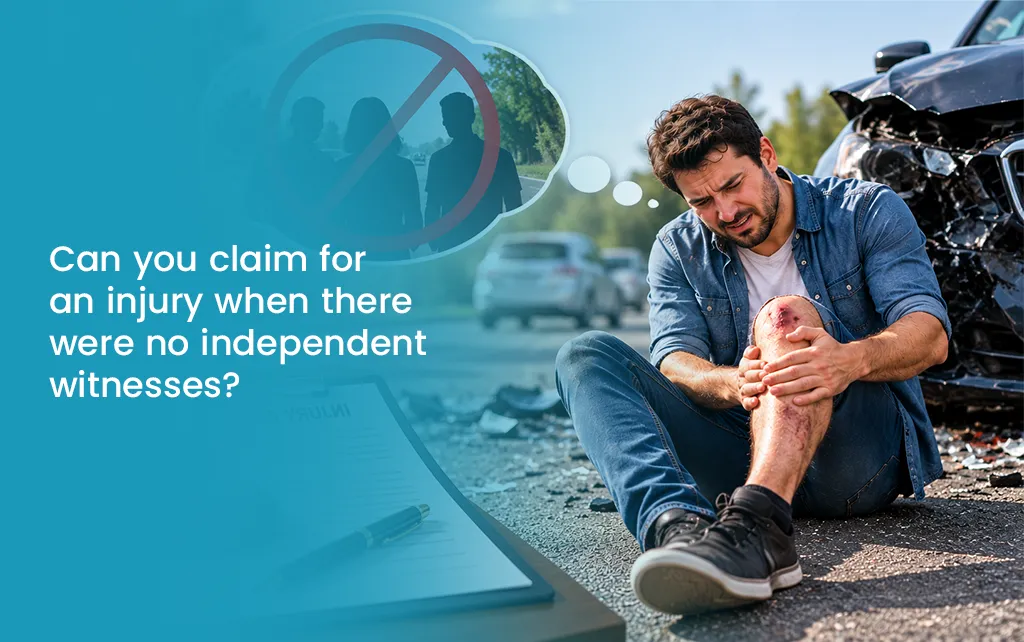
Many injured people leave an accident with the same worry: nobody else saw what happened, so who will believe them? A fall in an empty stockroom, a collision on a quiet road or a trip on a broken paving slab early in the morning can all leave you hurt with no independent witness to support your account.
The short answer is yes. You can bring a personal injury claim without witnesses in the UK. Independent witnesses can strengthen a case, but the law does not require one before you start. Whether the claim succeeds depends on the circumstances, the legal rules that apply and the strength of the other evidence. This guide explains how that evidence works, what challenges to expect and when personal injury solicitors can help.
Yes. You can start a claim without an independent witness, and many successful claims rely on other types of evidence instead.
It helps to separate three stages. Making a claim means notifying the other party and their insurer that you hold them responsible for your injury. Proving liability means showing, on the evidence, that they caused your injury through a legal fault. Securing compensation means the other side accepts responsibility, or a court decides they bear it, and then pays damages that reflect your injury and losses.
An independent witness is someone with no connection to you or the other party, such as a passer-by or a customer in a shop. Your own account counts as evidence, and so do documents and physical or digital records. A friend or relative who saw the accident can also give evidence, although the other side may question their independence.
Personal injury claim eligibility depends on three broad questions: whether the other party owed you a duty of care, whether they breached it, and whether that breach caused your injury. The Personal injury claim process and its time limits also differ between England and Wales, Scotland and Northern Ireland, so the jurisdiction matters from the outset.
Medical records, photographs, CCTV, accident reports, written notes, messages and physical evidence can all support a claim. How much weight each carries depends on the facts.
Evidence for personal injury claims in the UK falls into several practical categories:
A realistic example shows how this works. A warehouse employee slips on a spillage in an empty aisle. No colleague saw the fall, but the employee photographed the spillage, reported the incident the same day, attended A&E that afternoon and later requested the cleaning schedule and the CCTV from the aisle. Each item alone has limits, yet together they build a coherent picture. This is a general illustration, not a description of an MRH Solicitors case.
You prove negligence by showing, on the balance of probabilities, that the other party owed you a duty of care, breached it, and caused your injury and losses. An eyewitness is one way to prove this, not the only way.
Negligence rests on four elements:
In civil claims, the claimant carries the burden of proof, and the standard is the balance of probabilities. In plain terms, you must show that your version of events is more likely than not to be true. That is a lower standard than the criminal test of beyond reasonable doubt. A court can accept a credible claimant’s account when documents, medical records and surrounding facts support it, even without an independent eyewitness.
A personal injury compensation claim also requires proof of the nature and extent of your injury. Medical evidence usually deals with that point, while liability evidence deals with how the accident happened.
Disputed liability is the main challenge in a personal injury claim with no independent witnesses. The other side may deny the accident happened as you describe, argue that they took reasonable precautions or claim that you caused or contributed to your own injury. A finding of contributory negligence can reduce compensation without defeating the claim entirely.
Your account alone does not guarantee success. Insurers and courts test accounts for consistency against records such as medical notes, accident reports, photographs and earlier statements. Inconsistencies, delays in reporting and exaggeration can all damage credibility. In England and Wales, a court can dismiss an entire claim where a claimant is found to be fundamentally dishonest about it, under section 57 of the Criminal Justice and Courts Act 2015. Accuracy matters more than a persuasive story.
When liability stays in dispute, the parties exchange evidence and documents, and expert opinions may follow. Some claims settle through negotiation. Others proceed to a court hearing, where a judge decides which account is more likely to be correct. Nobody can promise an outcome in advance.
Yes. Each type of accident has its own legal framework and its own useful evidence, and a lack of independent witnesses does not automatically end any of them.
Employers owe their staff a duty to take reasonable care for their safety, and health and safety regulations, such as those covering risk assessment and work equipment, shape what reasonable care looks like. Evidence often sits in the employer’s own records: accident book entries, risk assessments, training records, maintenance logs and any report made to the Health and Safety Executive. Colleagues may have seen the accident, but their evidence can raise independence questions, so documents often carry extra weight. If you want to understand how a personal injury compensation claim works after an accident at work, the employer’s records are usually where investigation starts.
Liability usually turns on who controlled the premises or the surface. In England and Wales, the Occupiers’ Liability Act 1957 sets the duty owed to lawful visitors, and Scotland and Northern Ireland have their own equivalent legislation. Where a local authority maintains a pavement or road, different rules under the Highways Act 1980 apply in England and Wales. Photographs of the hazard, measurements, inspection and repair records, weather conditions and any report to the occupier all help. A claim after a slip or trip accident often depends on how long the hazard existed and whether the occupier had a reasonable inspection system.
Road collisions often leave more evidence than people expect. Vehicle damage, photographs, dashcam footage, police reports, nearby CCTV or traffic cameras, and vehicle data can all show how a collision happened. If the other driver left the scene or you cannot trace them, the Motor Insurers’ Bureau may handle some claims, and you should report the incident to the police promptly. Low-value injury claims after a road traffic accident in England and Wales may follow a streamlined process, which makes early advice on the correct route worthwhile.
Get medical attention, record what happened, preserve evidence, report the incident and seek legal advice promptly. Each step protects your ability to prove your case later.
Speaking to personal injury solicitors early gives you the best chance to preserve evidence before it disappears.
Personal injury solicitors can assess the evidence you have, identify what else may exist, advise on liability and time limits, and manage communication with the other side.
A solicitor looks at the whole picture rather than a missing witness. That usually means reviewing your account and medical records, asking for employer or occupier documents, tracing and requesting CCTV or other footage, considering expert evidence and assessing how an insurer might challenge the claim. A solicitor can also explain the relevant limitation period, the likely stages of the process and the risks of a disputed claim, without promising any particular result.
MRH Solicitors handles personal injury matters, including accidents at work, slip and trip accidents and road traffic accidents. Its website states that it represents clients across England and Wales, and readers in Scotland or Northern Ireland should check the position before making contact. The firm is authorised and regulated by the Solicitors Regulation Authority. You can read about funding on the MRH Solicitors funding page, or contact the team to ask how it might assess your circumstances.
No. A witness can help, but the law requires you to prove your case on the balance of probabilities by whatever admissible evidence is available. Records, photographs, medical evidence and your own credible account can all contribute.
Medical records prove your injury, your treatment and often its timing. They rarely prove how the accident happened or who was at fault, so you need other evidence for liability.
Footage can show the hazard, the accident or the events immediately before and after. Operators often delete it within weeks, so ask for a copy quickly. If no footage exists, a claim can still succeed on photographs, reports, maintenance records, medical evidence and your own account.
The general limit is three years in England and Wales, Scotland and Northern Ireland. The period usually runs from the date of the accident or the date you first knew your injury was linked to someone else’s fault. Different rules apply to children, to people who lack mental capacity, to criminal injury schemes and to some other cases, and courts can sometimes allow late claims. Seek advice early rather than waiting.
Yes, they can give a witness statement about what they saw or about your condition afterwards. The other side may question how independent they are, so supporting documents remain important.
The absence of independent witnesses does not automatically prevent someone from making a personal injury claim, but the available evidence and the legal circumstances will determine whether the claim can succeed. Prompt medical care, accurate records, preserved photographs and requests for CCTV all strengthen your position, and early advice helps you avoid missing a time limit.
If you suffered an injury and nobody else saw it happen, MRH Solicitors can help you understand your options and the evidence you may be able to rely on. A short conversation can show whether a personal injury compensation claim looks realistic in your circumstances, and what to do next.
The information provided is for general informational purposes only and does not constitute advice. While we strive to ensure the information is accurate and up-to-date, we make no representations or warranties of any kind, express or implied, regarding the accuracy, adequacy, validity, or completeness of any information on this site.