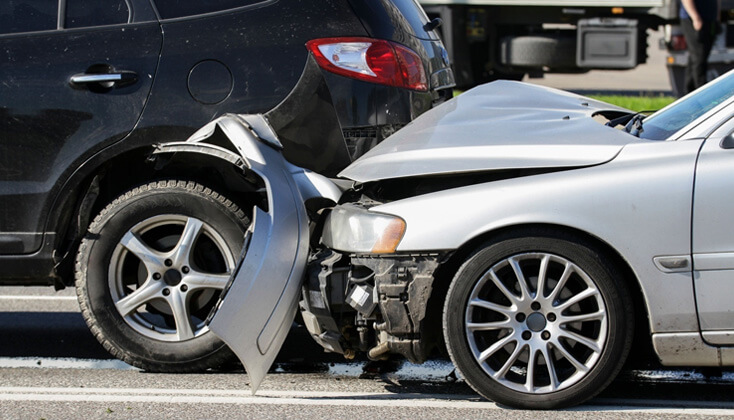
If you have been involved in a road traffic accident, you are probably dealing with two separate problems at once: a damaged car and an injury that is affecting your daily life. The good news is that you do not have to choose between the two. In most cases, you can make a claim for vehicle damage and personal injury at the same time, provided the accident was not your fault, or was only partly your fault.
This distinction matters because many people assume that once their insurer has dealt with the vehicle repair, that is the end of the matter. It is not. Vehicle damage and personal injury are treated as two separate heads of loss under UK law, and each has its own evidence requirements, time limits, and compensation rules. Understanding how they interact, and how to pursue both correctly, can make a significant difference to the amount of compensation you ultimately receive.
At MRH Solicitors, we handle claims covering both financial loss and physical harm every day. This guide explains, in plain English, exactly how a combined claim for vehicle damage and personal injury works, what evidence you need, who pays for what, and why getting specialist legal advice early can protect your interests from the outset.
Yes. If another driver caused or contributed to the accident, you are entitled to pursue a personal injury claim after a road traffic accident and a separate vehicle damage claim against the same at-fault party or their insurer.
These are legally distinct claims, even though they arise from the same incident:
Both claims stem from the same negligent act, but they are calculated, evidenced, and often processed through different channels. A solicitor experienced in road traffic accident compensation will run both strands of your claim in parallel, so that neither is delayed or undervalued while the other is being settled.
Insurers sometimes settle vehicle repair costs quickly, particularly where liability is clear. This can leave claimants with the impression that the matter has been fully resolved. In reality, a quick repair settlement often has nothing to do with the personal injury element of the claim, which may take longer to value properly because it depends on medical evidence and the long-term impact of your injuries. Accepting a vehicle repair payment does not affect your right to pursue injury compensation separately.
Understanding the practical differences helps you know what to expect at each stage.
| Feature | Vehicle Damage Claim | Personal Injury Claim |
| What it covers | Repair costs, write-off value, hire car, recovery, storage | Pain and suffering, medical costs, loss of earnings, rehabilitation |
| Evidence needed | Repair quotes, photographs, garage invoices | Medical reports, GP records, witness statements |
| Typical timescale | Often resolved within weeks | Can take months, depending on recovery and prognosis |
| Legal basis | Property damage claim | Personal injury compensation claim |
| Time limit | 6 years (Limitation Act 1980) | 3 years (Limitation Act 1980) |
Within a personal injury claim, compensation is split into two categories:
Vehicle damage often sits partly within special damages when the loss has not already been recovered elsewhere, which is one reason the two claims are closely linked even though they are assessed differently.
Strong evidence is the foundation of any successful claim. The earlier you start gathering it, the stronger your position will be.
Where police attended the scene, their report can be invaluable in establishing how the accident happened and who was responsible. Even where no report was filed, accident evidence such as dashcam footage, CCTV from nearby premises, and contemporaneous witness accounts can be decisive in disputed liability cases. A solicitor will know how to request and preserve this evidence before it is lost or deleted.
This is one of the most common questions we are asked, and the answer depends on liability.
The at-fault driver’s insurer is responsible for the full cost of repairing your vehicle, or its market value if it is written off. You are entitled to have your car restored to its pre-accident condition, using parts and materials of a reasonable standard, without being asked to accept cheaper alternatives that compromise safety or quality.
Many people use their own motor insurance policy to get repairs underway quickly, particularly if they need their car back on the road. Your insurer will usually then seek to recover its outlay from the at-fault driver’s insurer through a process known as subrogation. If you have an excess payment, this should also be recovered and refunded to you once liability is confirmed.
A personal injury solicitor with experience in road traffic accident claims will ensure none of these ancillary costs are missed when negotiating with insurers.
A vehicle is declared a total loss, or write-off, when the cost of repair exceeds a certain proportion of its pre-accident market value, or when it is no longer safe or economical to repair.
The insurer will instruct an engineer to assess the vehicle and determine its pre-accident value (PAV), based on factors such as:
You are entitled to challenge a valuation you consider too low. Evidence such as recent MOT certificates, service records, receipts for recent repairs or upgrades, and adverts for comparable vehicles can all support a higher settlement figure.
If your vehicle was on finance, the settlement is typically paid to the finance company first, with any surplus paid to you. If the settlement figure is less than the outstanding finance, you may be left in a shortfall known as “negative equity.” GAP insurance, if you hold it, can cover this shortfall. Where GAP insurance is not in place, a solicitor can help you challenge the insurer’s valuation to minimise the gap.
Yes. If your vehicle is undriveable or being repaired, you are entitled to claim for reasonable financial losses caused by being without it.
Beyond the vehicle itself, you may be entitled to recover:
These are collectively known as uninsured losses, and they are frequently underclaimed because policyholders are unaware they can recover them separately from their insurance excess.
Personal injury compensation is designed to put you back in the position you would have been in had the accident not happened, as far as money can achieve that.
This covers the physical pain, psychological impact, and the effect on your quality of life. Common road traffic accident injuries include:
The level of whiplash compensation and other general damages is guided by medical evidence, the severity and duration of symptoms, and the impact on your ability to work, exercise, and carry out everyday tasks.
An independent medical assessment is central to valuing a personal injury claim accurately. The examining specialist will consider your injuries, treatment to date, and likely prognosis, and will produce a report used to value your claim fairly. Where recovery is ongoing, a further review may be arranged closer to settlement to ensure long-term effects are properly accounted for.
You can still claim compensation even if you were partly responsible for the accident, under a principle known as contributory negligence.
If you are found to be, for example, 20% responsible for the accident, your compensation will be reduced by 20% to reflect your share of fault. This applies to both the personal injury claim and the vehicle damage claim.
Common scenarios involving shared liability include:
Liability disputes are one of the most contentious aspects of road traffic accident claims. Insurers will often try to allocate a greater share of blame to you in order to reduce their payout. A solicitor experienced in road traffic accident solicitors‘ work will gather independent evidence, challenge unfair liability assessments, and negotiate firmly to ensure any reduction in compensation reflects the true circumstances of the accident, not simply the insurer’s opening position.
UK law sets strict time limits, known as the limitation period, within which a claim must be started.
Missing the relevant deadline can mean losing your right to compensation entirely, regardless of how strong your case would otherwise have been. It is always best to seek legal advice after a road traffic accident as early as possible, ideally within weeks rather than years, so evidence can be gathered while memories and documentation are still fresh.
We strongly recommend seeking independent legal advice before accepting any settlement offer, for both vehicle damage and personal injury.
Insurers may make an early settlement offer before the full extent of your injuries is known, or before all your financial losses have been calculated. Once you accept a settlement and sign a discharge form, you generally cannot go back and ask for more, even if your symptoms later worsen or you discover additional losses.
An experienced solicitor adds value at every stage of the process by:
At MRH Solicitors, we understand that a road traffic accident affects far more than your car. It can disrupt your income, your health, and your peace of mind. Our approach is built around handling both elements of your claim, vehicle damage and personal injury, together, so that you receive comprehensive compensation without unnecessary delay or duplicated effort.
Our Road Traffic Accidents Solicitors manage every stage of the process on your behalf, from establishing liability and arranging medical assessments to negotiating firmly with insurers who may attempt to undervalue your claim. We understand how insurers approach these cases, and we use that knowledge to protect your interests rather than theirs.
Whether your case involves a straightforward repair claim, a vehicle write-off, a contested liability dispute, or a serious personal injury requiring long-term rehabilitation, our Road Traffic Accidents Claims team provides clear, personalised legal advice at every step. We keep you informed in plain English throughout, so you always understand where your claim stands and what happens next.
If you have been involved in a road traffic accident, you do not need to choose between claiming for your vehicle damage and pursuing a personal injury claim. In the vast majority of cases, both can and should be pursued together, ensuring you are fully compensated for repair costs, replacement vehicle expenses, medical treatment, lost earnings, and the pain and disruption caused by your injuries.
Insurers are not obliged to tell you about every loss you are entitled to recover, and settlement offers made without legal advice frequently undervalue a claim. Acting quickly, gathering strong evidence, and seeking specialist legal advice from the outset gives you the best possible chance of securing the full compensation you deserve.
MRH Solicitors has extensive experience guiding clients through combined vehicle damage and personal injury claims, providing expert legal representation, personalised advice, and skilled negotiation with insurers from start to finish. If you have been injured or your vehicle has been damaged in a road traffic accident, contact MRH Solicitors today for a free, no-obligation consultation, and let our experienced team help you claim the compensation you are rightfully owed.
“The information provided is for general informational purposes only and does not constitute advice. While we strive to ensure the information is accurate and up-to-date, we make no representations or warranties of any kind, express or implied, regarding the accuracy, adequacy, validity, or completeness of any information on this site.”